
Why line side storage matters on a busy packing line
On most packing lines, the cutter or dispenser is only part of the job. The real pressure comes from where it is kept, how quickly an operator can reach it, and whether spare blades, tape knives, and small fittings are close enough to hand without creating a mess. When tools get left on pallets, stacked on cartons, or dropped into random containers, they are more likely to get damaged, go missing, or pick up dirt that should not be anywhere near the product area.
Good line side storage helps reduce searching and repeat handling. That matters in Germiston warehouses, Boksburg depots, and larger sites in Johannesburg or Durban where one lane may run all day and another may be switched over more than once. The aim is simple: every item has a place, the place is easy to reach, and the operator does not need to walk away from the line just to find a cutter or spare part.
It also protects the equipment itself. A cutter left loose on a steel surface or on top of wrapped stock can take knocks that bend the body, nick the blade, or throw the alignment off. That leads to poor film application, wasted film, and avoidable downtime. On a tight shift, that is money gone for no good reason.
Set up a storage point within arm’s reach
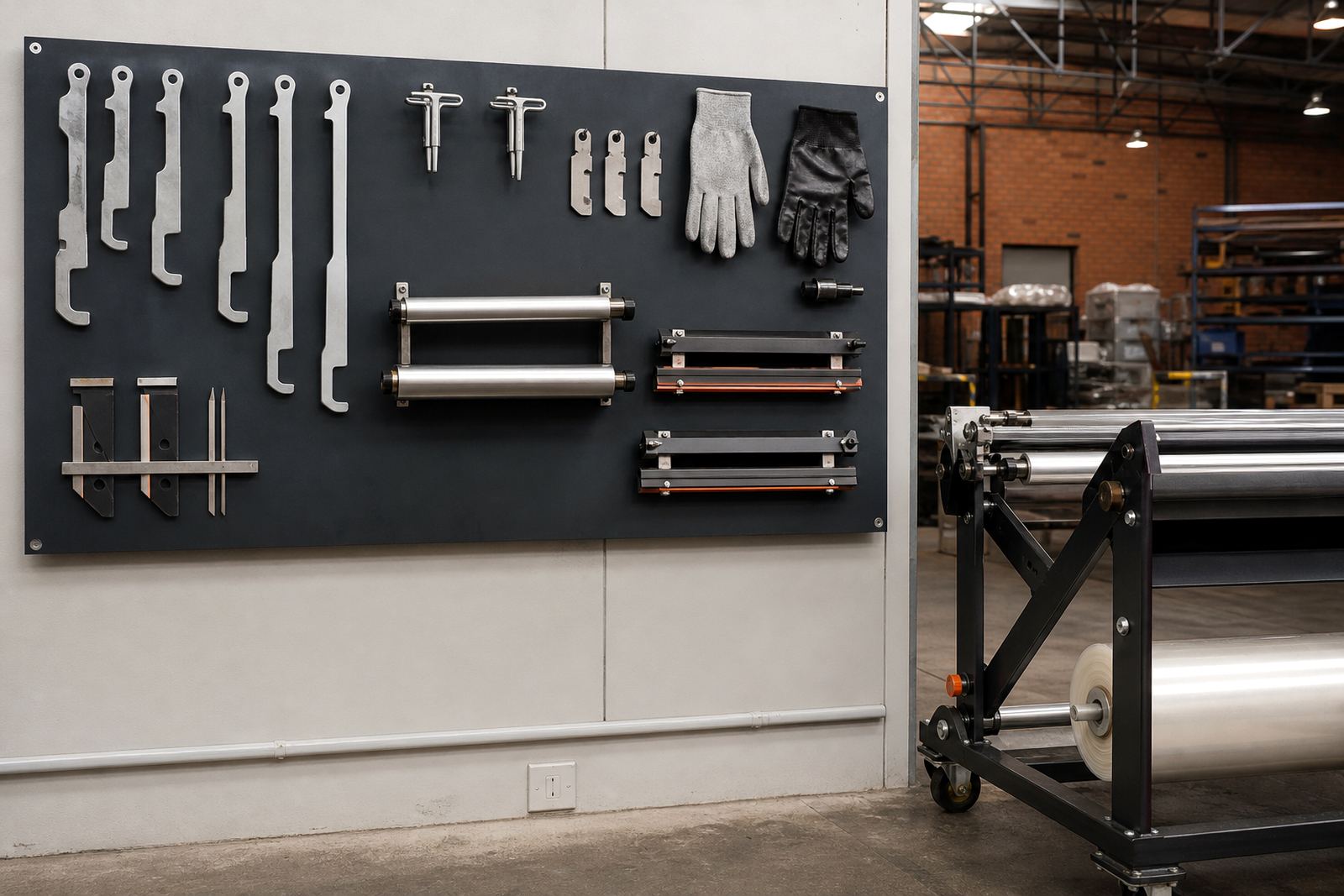
The best storage point is close enough to the working position, but not so close that it becomes a snag point. Think about the operator’s natural movement: reach for film, cut, secure, move to the next pack. Storage should fit into that rhythm. A simple wall-mounted holder, side rack, or small fixed tray can work well if it stays clear of moving rollers and conveyor edges.
Keep in mind that South African packing rooms are not all the same. Some sites in Cape Town deal with salt air and coastal humidity, while inland sites in Pretoria or Polokwane may face dust and heat. If storage is open and exposed, metal parts can corrode and plastic parts can become brittle faster than expected. Covered storage or a dry cabinet near the line can help, especially where washdown, condensation or temperature changes are part of the daily routine.
- Keep the main cutter or dispenser in the same position every shift.
- Store spare blades in a locked or controlled container.
- Separate clean tools from dirty maintenance items.
- Use labels so any operator can find the right item fast.
Keep cutters, spares and consumables separated
One common mistake is to store everything in one box. That might look neat at first, but it creates confusion when blades, screws, rollers and cleaning cloths all end up in the same place. Line side storage works better when the job items are split by function. The cutter should have one position, spares another, and consumables a third. That makes stock control easier and reduces the chance of putting the wrong part into service.
This matters for safety too. Blades should never lie loose in an open tray where someone can reach in too quickly. Even a small nick can stop a shift or create a reportable incident, depending on the site rules. In many factories, especially those handling food or personal care packs, tidy storage also supports hygiene rules and audit checks. If the line is inspected by a supervisor or customer rep, a clear storage system says a lot about how the site is run.
- Use sealed containers for blades and sharp spares.
- Keep replacement parts in marked bins by size or model.
- Do not mix maintenance tools with packing tools.
- Record what is removed and what is returned each day.
Prevent accidental cutter damage with simple physical controls
Many cutter failures start with small knocks. A unit falls from a crate, gets clipped by a trolley, or lands under a loose pallet edge. Once that happens, the dispenser may stick, the blade may not seat properly, or the housing may crack. A small storage change can prevent that. Fit a holder that supports the full tool, not just the handle. If the cutter is stored upright, make sure it cannot tip over. If it is stored flat, make sure it cannot slide off the edge of the bench.
On sites with fast changeovers, it helps to have one fixed station for the current line and one backup station for maintenance stock. That way the working tool stays protected while the spare is kept ready for breakdowns or scheduled replacement. It also makes preventive servicing simpler because the service team can check the stored unit, clean it and return it to a known position.
For plants that run through load-shedding or generator changeovers, secure storage matters even more. During power interruptions, people tend to move quickly and equipment gets shifted around. If cutters are left loose, they are far more likely to get lost or damaged in the confusion.
Use storage rules that suit the operator, not just the auditor
A storage system only works if operators use it without needing to think too hard. The layout should be practical and quick. If a person has to unlock three containers or cross the line to get a spare part, they will eventually leave items on the nearest flat surface. That is how clutter starts. Good line side storage should be obvious, physical and simple to follow on night shift as well as day shift.
When we look at packing lines in Johannesburg, Midrand or Durban, the sites that hold up best are usually the ones with basic rules everyone understands. The right setup is not fancy. It is tidy, repeatable and easy to train. A short operator guide near the storage point can help, especially where multiple people share the same line across shifts.
- One home position for the active tool.
- One marked place for backup cutters and dispensers.
- One closed container for sharp spares.
- One cleaning point for cloths and safe wipe-down items.
- One person responsible for end-of-shift return checks.
A Germiston example that shows the difference
A packaging site in Germiston with a few packing lanes was struggling with missing cutters, damaged dispensers and constant small delays. Operators were keeping tools on top of cartons or in the nearest drawer, so nobody knew what was available at any moment. After a simple line side storage review, the site changed to fixed holders, labelled spare bins and a controlled blade container near each packing point.
The result was not dramatic in the flashy sense, but it was practical. Search time dropped, damaged tools reduced, and the supervisor could see at a glance when stock needed topping up. The team also found it easier to train new staff because every line looked the same. That kind of consistency is valuable in busy areas like Germiston and Boksburg, where shifts change, trucks arrive early and everyone is under pressure to keep product moving.
For larger facilities that run several lines at once, the same idea can be copied line by line. Start with the highest-use packing point, then standardise the storage layout across the site. It keeps the operation tidy and makes support easier when a breakdown callout or equipment upgrade is needed.
How Film Cutters supports safer line side storage
Line side storage is not only about shelves and bins. It also depends on the right cutter and dispenser setup, plus sensible servicing and training. If the tool is awkward to return to its place, operators will stop using the storage system properly. If a dispenser needs constant repairs, it will end up on the line where it should not be. That is why support should cover installation, line setup, preventive servicing, blade replacement, dispenser repairs, spares supply and operator training.
We work with packing lines across South Africa, including Johannesburg, Pretoria, Durban, Cape Town and Polokwane, from our Germiston base in Ekurhuleni. For sites that need help with storage layout, safety checks, roll change support or breakdown callouts, the first step is usually a site assessment. That lets us see how the line works in real conditions and where storage is causing extra handling or clutter.
When line side storage is done properly, the benefits show up every day: less searching, fewer damaged cutters, safer blade handling and better control over the packing area. It is a small change that saves time and keeps the line moving.