
1. A Neat Cut Turns into a Ragged Edge
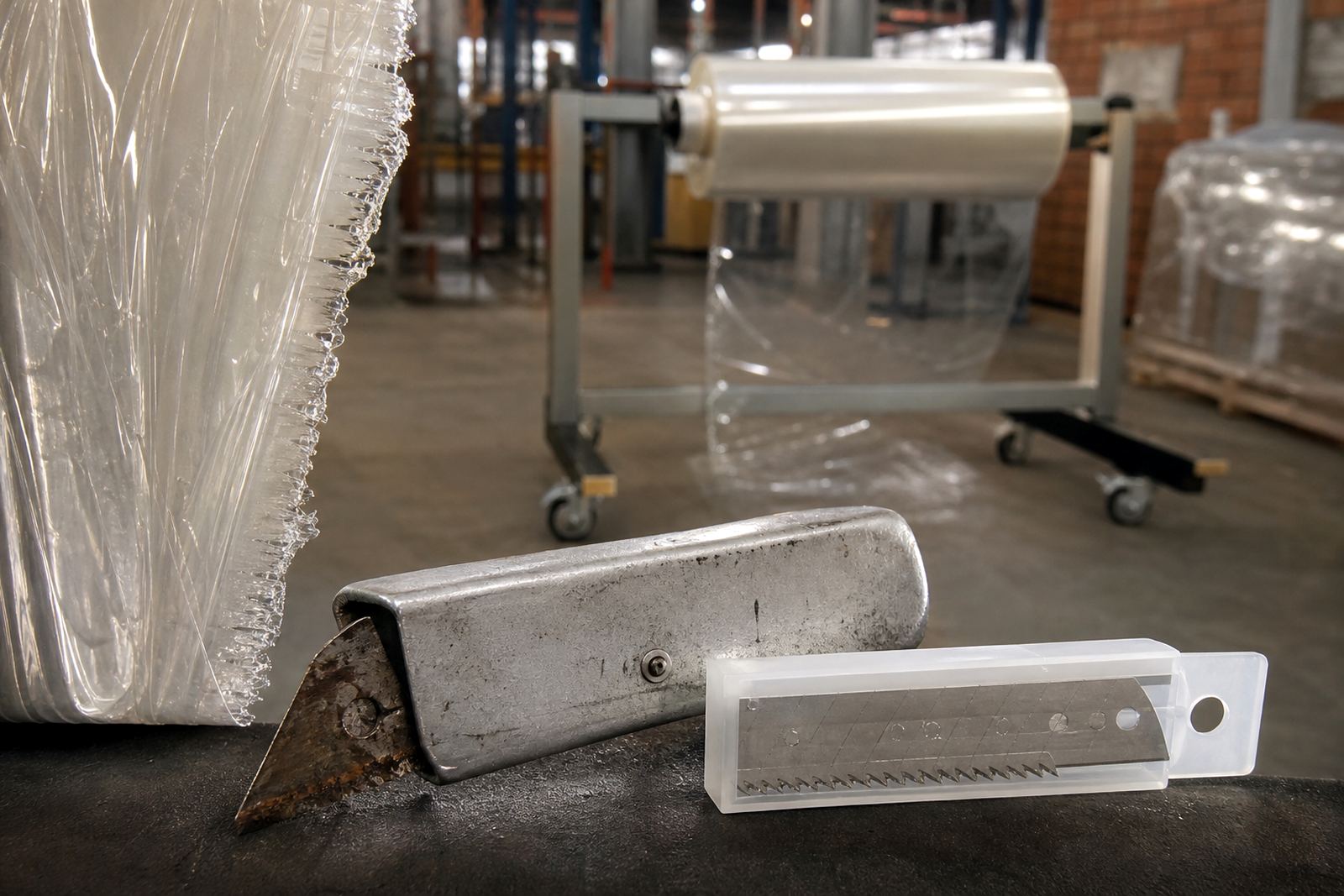
The first sign is often visual. Instead of a clean, straight cut through shrink film or stretch film, the edge starts to look feathered, stretched, or torn. The film may cling unevenly, leave stringy bits behind, or pull out of shape when the operator cuts by hand or through a dispenser.
On fast packing lines this can be missed for a few shifts, but the damage adds up. Ragged cuts make the pack look untidy and can affect how the film seals around the load. If your team has to trim off loose ends more often, the blade is already past its best.
2. Operators Start Using More Force
A sharp blade should do the work with light pressure. When staff begin pushing harder, leaning into the cutter, or making a second pass to finish the cut, the blade is telling you it is dull. That extra force slows the line and increases the chance of slips, cuts, and sore wrists by the end of the day.
- More pressure needed to start the cut
- Repeated passes on the same film
- Operators avoiding the cutter and using makeshift tools
- Visible hesitation before each cut
In Germiston and Boksburg, where many sites run long shifts and shift handovers are tight, this is one of the most common early complaints. If the cutter no longer feels easy to use, do not wait for a failure on the floor.
3. Film Starts Snagging or Bunching Up
A worn blade does not glide through film evenly. Instead, the material may snag at the edge, bunch up near the cut line, or pull tight before it releases. This is a problem on both shrink film and stretch film lines because the film has to feed consistently to keep the pack uniform.
Snagging can also point to a blade that has picked up residue, small nicks, or alignment issues in the dispenser. In humid coastal areas such as Durban, film can pick up dust and fine grime more quickly, so a dull blade may show its weaknesses sooner than expected.
Keep an eye on these signs:
- The film sticks before it parts
- The cut line shifts from one side to the other
- The dispenser feels rough instead of smooth
- The film edge curls or frays after cutting
4. Cut Quality Drops on Different Roll Sizes
Some blades seem fine on one roll size, then struggle as soon as the roll width, thickness, or tension changes. That inconsistency is a useful warning. A healthy cutter should handle normal variation without needing constant adjustment from the operator.
If the blade performs poorly on thicker gauge film, on wider rolls, or during heavier wrap cycles, it may already have lost its edge. This shows up often during seasonal demand spikes, when packing lines in Johannesburg or Pretoria are pushed harder and the team has less time to stop and reset equipment.
Ask the line supervisor to compare performance across different jobs. If the same cutter only works properly on certain loads, replacement is usually the better call than patching the problem with adjustments.
5. More Waste, Rework, and Downtime Start to Show
Dull blades rarely stay a small issue. They begin to affect output in ways that cost time and money. You may see more offcuts, more rewrapping, or more rejected packs because the film has torn or failed to sit properly around the product.
At that point the line is paying for the blade twice, once in wasted film and again in lost time. On sites with load-shedding backup plans, every minute matters because operators often have a shorter window to catch up after power interruptions. A slow cutter can become the reason the shift never recovers.
- Higher film usage per pallet or pack
- More rework at end of line
- Frequent stoppages to clear jams
- Slower pack completion during peak shifts
6. Safe Replacement Matters as Much as Sharpness
Blade wear is not only about finish quality. A blunt blade can make operators take shortcuts, and that is where safety risks increase. Staff may press harder, lift guards incorrectly, or try to clear stuck film without stopping the line properly. That is where injuries happen.
Before replacing a blade, the area should be isolated, the cutter inspected, and the correct spare fitted. A proper safety check also looks at the holder, tension points, and any damaged parts around the dispenser. If the blade keeps going dull too quickly, there may be an alignment or handling issue that needs attention too.
A practical site check should cover:
- Blade condition and edge wear
- Holder alignment and tightness
- Film residue build-up
- Operator handling and cut method
- Guarding and safe access for change-out
7. A Local Example from a Busy Ekurhuleni Line
At a packing site in the east of Ekurhuleni, the team noticed that stretch film was starting to tear unevenly near the end of each shift. The line still ran, so the issue was put off for a few days. By the following week the operators were using more force, roll changes took longer, and the packing area had more loose film offcuts on the floor.
The cause was a dull blade in the dispenser, not a problem with the film itself. Once the blade was replaced and the setup checked, the cut became clean again and the team cut back on rework straight away. The lesson is simple: if the first signs appear, act early. It is cheaper to replace a worn blade than to keep paying for extra waste, slower work, and avoidable callouts.
For businesses in Germiston, Midrand, Boksburg, Polokwane, Cape Town, Durban, Pretoria, and Johannesburg, regular inspection is the easiest way to stay ahead of blade wear. If the cutter no longer gives a clean line, it is time to inspect, replace, and get the packing line back on track.